Sharvari Hospital · Pimple Nilakh, 5 min from Wakad
Fistula Doctor in Pune — Dr. Kundan Kharde, MS FMAS (19+ Years, 6,000+ Surgeries)
Medically reviewed by Dr. Kundan Kharde, MS (General Surgery), FMAS · Last updated: 18 September 2026
MBBS MS (General Surgery) MMC Reg. No. 2013113384 Verify
Dr. Kundan Kharde, MS FMAS, is a proctology and laparoscopic surgeon who treats anal fistula with FiLaC, VAAFT, LIFT, seton or fistulotomy — chosen from your tract anatomy, not a package. Surgery is at Sharvari Hospital, 50-bed, Pimple Nilakh, 5 min from Wakad, 24×7. Most cases are day-care; desk work resumes in 2–5 days. Results vary.
Quick definition
An anal fistula is an infected tunnel between the anal canal and the skin near the anus, usually left behind after a perianal abscess. It causes discharge, wetness, itching and repeat swellings, and it does not close on its own with antibiotics. Treatment is a tract-directed operation — fistulotomy, laser (FiLaC), LIFT, VAAFT or a staged seton — chosen after mapping the tract on MRI or ultrasound.
What is an anal fistula, and how does it show up?
An anal fistula is an abnormal passage between the anal canal (or occasionally the rectum) and the skin around the anus. It usually forms after a perianal abscess drains or is drained, leaving a tunnel lined with inflammatory tissue. Common associations are previous abscess surgery, Crohn’s disease, tuberculosis in endemic settings and, rarely, malignancy or radiation injury. Because the tract may pass through the sphincter muscles that control continence, treatment must balance complete healing with preservation of function.
Symptoms that point to a fistula
- Persistent pain or throbbing around the anus, worse on sitting
- Pus or blood-stained discharge from a small opening near the anus
- Swelling, redness or tenderness that comes and goes
- Recurring anal abscesses, sometimes with fever
- Irritated, wet or itchy skin around the external opening
These overlap with piles and fissure, and misdiagnosis online is common — see fistula vs piles. If a fistula has already been operated on once or more, read how I approach complex and recurrent fistula — fresh MRI re-mapping, why the last operation failed, and a staged sphincter-preserving repair.
How I decide which fistula operation to do
I image almost every fistula before I operate. The tract decides the operation, not the marketing.
Step 1 — I map the tract before I decide
I image almost every fistula patient before surgery — an MRI fistulogram or a trans-rectal ultrasound. The tract's path, its depth, how much sphincter muscle it crosses and whether there are hidden side branches cannot be judged from an external opening alone. Operating on an unmapped tract is how fistulas recur and how continence is lost. Once I can see the tract, the choice of operation follows from it.
| What I find | What I do | Why |
|---|---|---|
| Early, simple, superficial tract | I do a fistulotomy (lay-open) | Highest cure rate; almost no sphincter muscle is involved, so continence is not at risk |
| Mature, fibrosed superficial tract | I do a fistulectomy | Removes the whole hardened tract rather than only opening it — lowers the chance of recurrence |
| Deep tract involving more than 50% of the external sphincter | I use a combination technique — proximal fistulotomy + distal core-out, with seton or laser (FiLaC) as required | Clears the tract while protecting continence. This is where single-technique centres either under-treat (recurrence) or over-cut (continence risk) |
| Recurrent, multiple or horseshoe tracts | I treat it in stages — seton first to settle sepsis, then the definitive procedure | Imaging has already shown every branch; treating it in stages clears all of them without cutting sphincter twice |
No single technique suits every fistula, and I do not promise an outcome before I have seen the tract. Which of these applies to you is decided after clinical examination and imaging — an MRI fistulogram or trans-rectal ultrasound — and confirmed at surgery. I operate at Sharvari Hospital, Pimple Nilakh; the hospital's programme is described at laser fistula surgery at Sharvari Hospital. Bring your reports.
Fistula surgery techniques compared — FiLaC, VAAFT, LIFT, seton, fistulotomy
The table shows how the five operations differ in what they suit, what they risk and how long they take to recover from. Recurrence figures are pooled ranges from the published literature cited under the table — they are not a promise for your fistula, which depends on its depth, branches and whether it has been operated on before.
| Technique | Best for | Sphincter risk | Day-care? | Recovery | Recurrence (published) |
|---|---|---|---|---|---|
| FiLaC (laser closure) | Trans-sphincteric tracts where cutting muscle is not safe; often combined with proximal fistulotomy | Very low — no muscle divided | Yes | Desk work 2–4 days | 25–40% non-healing in pooled series (Elfeki 2020) |
| VAAFT (video-assisted) | Complex or branched tracts where the internal opening or side branches need to be seen from inside | Very low | Yes / overnight | Desk work 3–5 days | 15–25% (Garg & Singh 2017) |
| LIFT (intersphincteric ligation) | Established trans-sphincteric tract with a mature, well-defined intersphincteric segment | Low | Yes / overnight | Desk work 5–7 days | 20–30% (Hong 2014) |
| Seton (draining / staged) | Sepsis control first; horseshoe, recurrent, Crohn’s and high tracts before definitive repair | Low (draining); cutting seton up to ~12% minor leakage | Yes | Back to work in days; definitive stage weeks later | 0–8% after cutting seton (Ritchie 2009) |
| Fistulotomy (lay-open) | Low, simple, superficial tracts involving little or no external sphincter | Low when the tract is truly low; rises with muscle involvement | Yes | Desk work 2–5 days; wound matures 3–6 weeks | 2–9% (healing >90%) (Gaertner 2022 (ASCRS)) |
Sources: Elfeki H et al., Colorectal Disease 2020 (FiLaC systematic review); Garg P & Singh P, International Journal of Surgery 2017 (VAAFT systematic review); Hong KD et al., Techniques in Coloproctology 2014 (LIFT systematic review); Ritchie RD et al., Colorectal Disease 2009 (cutting seton systematic review); Gaertner WB et al., ASCRS Clinical Practice Guideline, Diseases of the Colon & Rectum 2022. Ranges are pooled published outcomes, not an audited personal series.
In practice I often combine them: a proximal fistulotomy for the superficial part with FiLaC for the segment crossing the sphincter, or a draining seton first and a definitive procedure weeks later. Detailed comparisons: FiLaC vs fistulotomy, laser vs open surgery, and VAAFT vs open on the blog.
Types of fistula I treat
Fistulas are classified by their relationship to the sphincter complex (Parks classification) and by complexity — simple versus complex, recurrent, horseshoe. The type decides which row of the table above applies.
| Type | What it means for treatment |
|---|---|
| Intersphincteric | Runs between internal and external sphincter; the commonest type, usually a straightforward lay-open if low. |
| Trans-sphincteric | Crosses the external sphincter; needs FiLaC, LIFT, VAAFT or a combination technique when deep. |
| Suprasphincteric | Rare; curves above the muscle complex; staged, sphincter-preserving planning. |
| Extrasphincteric | Rare; usually secondary to Crohn’s, trauma or pelvic disease; the cause is treated alongside the tract. |
| Horseshoe | Branched abscess around the anus; staged drainage and setons before definitive repair. |
| Complex / recurrent | Prior failed surgery, multiple openings or Crohn’s — fresh MRI, exclusion of TB, staged repair. |
High or horseshoe tracts and fistulas that have come back after one or more operations behave differently: the internal opening is harder to find, scarring distorts the anatomy, and repeating the same operation usually fails the same way. These cases are planned on a fresh MRI, with Crohn’s disease and tuberculosis excluded where indicated — see complex and recurrent fistula treatment.
Credentials you can check
Anyone can call themselves a fistula specialist. These are the registrations behind this page, with links to the registers that hold them.
- Surgeon
- MBBS (2007) · MS General Surgery (2013), Dr. D. Y. Patil Medical College, Pimpri · FMAS (Fellowship in Minimal Access Surgery)
- Medical council
- Maharashtra Medical Council Reg. No. 2013113384, valid to 12 November 2028 — verify on Know Your Doctor · verification page
- Published work
- Published surgeon · Lokmat columnist · MMC-verified — press & publications →
- Hospital
- Sharvari Hospital, Pimple Nilakh — 50-bed, ISO 9001:2015 certified; PCMC Nursing Home Registration No. 884 (Bombay Nursing Homes Registration Act, 1949)
- Professional bodies
- Indian Medical Association (IMA) · Association of Minimal Access Surgeons of India (AMASI)
19+ years in surgery and 6,000+ operations across proctology and laparoscopy — which matters for fistula because patients often carry a second problem (hernia, gallbladder) that can be handled under the same roof. More on training and philosophy on the about doctor page.
Where the surgery happens
Consultations run at Wakad (Pimple Nilakh), Baner and Hinjawadi. Every fistula operation is done at Sharvari Hospital, Pimple Nilakh — SR. NO. 19(P), behind Gulmohor Park, Vishal Nagar, Pimple Nilakh, Pune 411027 — five minutes from Wakad Chowk, with a 24×7 emergency desk, in-house OT and overnight beds when a staged or complex repair needs them.
Room rates, package inclusions, bed categories and insurance tie-ups are published on the hospital’s own page: fistula surgery at Sharvari Hospital — costs, beds, insurance.
A recent case: one MRI, one plan, no guessing
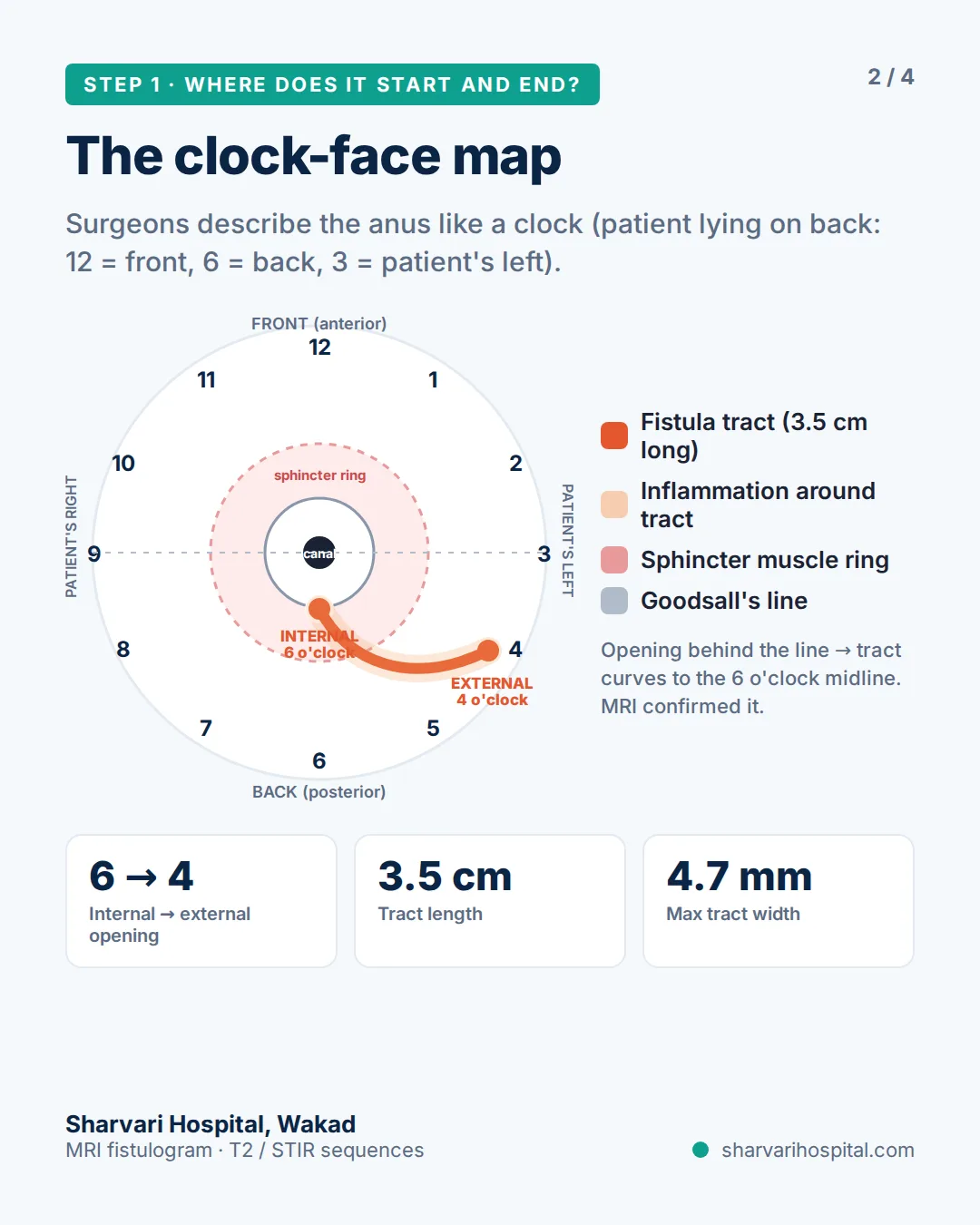
A patient came to me with a discharging opening at the 4 o'clock position, and the MRI fistulogram showed a trans-sphincteric tract running from there to an internal opening at 6 o'clock, crossing the external sphincter on the way. In theatre the probe followed exactly the path the scan had drawn, so there was no hunting for the internal opening and no surprise branch. I laid open the proximal, superficial part of the tract with a fistulotomy and closed the segment passing through the external sphincter with FiLaC laser, so the muscle itself was not divided. That is what imaging buys: one map, one plan, and a sphincter left intact.
Read the full case on the Sharvari Hospital site →
How I map a fistula on MRI →
Your fistula care pathway, step by step
- Consultation and examination: history, examination and usually proctoscopy to find external openings and assess continence. Bring prior MRI or operative notes if treated elsewhere.
- Imaging before surgery: an MRI fistulogram or trans-rectal ultrasound in almost every case. The scan shows the internal opening, how much sphincter the tract crosses and any hidden branch — and that decides between a lay-open and a sphincter-preserving plan.
- Plan discussion: which technique and why, realistic recurrence risk, time off work and the cost band, before you consent.
- Day-care or short-stay surgery: 30–60 minutes under spinal or general anaesthesia in a sterile OT; same-day discharge is usual for simple and moderate tracts.
- Follow-up: wound review at one, two and four weeks, written aftercare, and a direct line for red-flag symptoms.
Fistula surgery cost in Pune and insurance
In private hospitals in Pune, fistula surgery commonly falls between ₹40,000 and ₹1,20,000, depending on complexity, technique (laser, LIFT, VAAFT, staged seton), anaesthesia, room category and length of stay. Recurrent, horseshoe and Crohn’s-related fistulas that need staged procedures sit at the higher end. Medically necessary fistula surgery is commonly admissible under standard health policies; cashless treatment depends on your insurer’s tie-up with the hospital, and reimbursement claims are filed with the discharge summary, bills and operative notes.
Full breakdown: fistula surgery cost in Pune. A written estimate follows examination — book by phone, WhatsApp or the contact page.
Watch: Understanding Fistula Treatment
Dr. Kundan Kharde explains fistula diagnosis, treatment options, and what to expect during recovery.
 Watch Video
When is a fistula an emergency?
Seek same-day attention for spreading redness, high fever, rigors, a rapidly enlarging painful swelling, difficulty passing urine or heavy bleeding — these point to an abscess or severe infection that needs drainage, not a routine clinic slot. A stable chronic fistula with intermittent discharge is rarely an overnight emergency, but it still deserves timely planning to stop the abscess cycle. If unsure, call +91 951 951 1928 so staff can triage.
Myths versus facts
Myth: “Antibiotics alone will cure my fistula.” Fact: They calm infection but rarely remove a mature tract; definitive care needs a procedure.
Myth: “Laser means no surgery.” Fact: FiLaC is still an operation under anaesthesia with recovery rules.
Myth: “The same operation works for every fistula.” Fact: High trans-sphincteric and Crohn’s-related tracts need sphincter-sparing or staged strategies.
Myth: “If the discharge stops, it has healed.” Fact: Quiet periods are common; recurrence usually follows without tract-directed treatment.
Recovery after fistula surgery
Typical timelines for uncomplicated laser or limited procedures — your discharge sheet is the authority for your case.
- Day 0–2: rest, prescribed pain relief, sitz baths twice daily, light high-fibre diet.
- Day 2–5: most desk workers resume work; avoid long sitting without breaks.
- Week 2–4: wound granulates; follow-up checks at one, two and four weeks.
- Week 4+: gym, cycling and heavy lifting only when cleared.
Call the same day for fever, increasing pain, heavy bleeding, inability to pass urine or spreading redness. Related reading: fistula recovery time, why fistulas don’t heal (FRIENDS) and non-surgical options — an honest overview.
Related information
Explore other services and symptoms that often overlap with anal fistula. These links are for education only — your plan is confirmed only after examination with Dr. Kharde.
Related treatments
Related symptoms
Learn more about Dr. Kundan Kharde's training and approach before your visit.
Helpful guides: anal fistula
Deep-dive articles for general education only — your treatment plan is individualised after examination with Dr. Kundan Kharde.
- Fistula in Ano: Diagnosis, Treatment and Recovery
- Why Fistulas Don't Heal: Understanding the FRIENDS Acronym
- Fistula Surgery Types: VAAFT vs Open Explained
- Fistula Surgery Recovery: What to Expect
- Hidden Fistula Presenting as Lower Back Pain
- Can Fistula Be Cured Without Surgery? A Surgeon's Honest Answer
- Fistula vs Fissure vs Piles: How to Tell the Difference
- Laser Fistula Surgery in Pune: Cost, Procedure & Recovery Guide
Main surgical centre: Wakad (Pimple Nilakh) location page · Contact / appointments
Areas we serve for anal fistula
Frequently asked questions — fistula doctor in Pune
How do you decide which fistula operation I need?
Do I need an MRI for a fistula?
What is the best treatment for anal fistula?
Can a fistula heal on its own without surgery?
How much does fistula surgery cost in Pune?
Is fistula surgery covered by insurance?
Is laser fistula surgery painful?
How long does fistula surgery take, and is it day-care?
How long does it take to recover from fistula surgery?
Will fistula surgery affect my bowel control?
Can a fistula come back after surgery?
What is the difference between fistula and piles?
Which type of doctor treats fistula, and where does Dr. Kharde operate?
Are you an MBBS (allopathic) surgeon?
Book a fistula consultation in Pune
Walk-in and online consultations (Mon–Sat, Mon-Sat: 10:00 AM - 8:00 PM). Surgery at Sharvari Hospital, Pimple Nilakh — Sharvari Hospital, SR. NO. 19(P), behind Gulmohor Park, Vishal Nagar, Pimple Nilakh, Pune 411027. Already scanned? Send your MRI report on WhatsApp.