Dr. Kundan Kharde · 19+ years · 6,000+ surgeries · 4.9 ★ · 140+ Google reviews
Redo Fistula Surgery: A Second Opinion After Failed Operations
Redo fistula surgery is a second or later operation for an anal fistula that has persisted or recurred after previous treatment. Dr. Kundan Kharde, a proctology surgeon in Pune with 19+ years of experience, assesses recurrent and complex fistula cases by re-mapping the tract on MRI, identifying why the previous surgery failed, and planning a sphincter-preserving — often staged — repair.
Send Your MRI for ReviewI want to say this first — a fistula that came back is a mapping problem, not a hopeless one
In my clinic I regularly see fistulas that are somebody else's second, third and occasionally fourth operation. Patients arrive having been told the surgery “went well” and yet the discharge returned in six weeks.
Almost every time, when I put that patient through a fresh MRI and an examination under anaesthesia, I find something the previous plan did not account for: a secondary tract nobody looked for, an internal opening that was never actually identified, or a disease process — Crohn's, or in a fair number of Indian patients, tuberculosis — that was never investigated.
That is a solvable problem. It just cannot be solved by repeating the same operation faster.
Send me your MRI and previous operation notes on WhatsApp — +91 99602 83338. I will read them before you make a trip.
Recurrent and high-complexity fistula after multiple previous operations — how I approach it
Step 1 — I read the previous operative note before I examine you
The note tells me what was found, what was divided, and what was left behind. It is the single most useful document you can bring, and most patients don't know to ask for it. If you don't have it, request it from the previous hospital — you are entitled to it.
Step 2 — Fresh MRI, always
I do not plan a redo fistula operation on clinical examination alone. Scar tissue from previous surgery distorts everything you can feel from outside. MRI with a fistula protocol shows me the primary tract, any secondary tracts, horseshoe extensions, undrained collections and, crucially, how much sphincter muscle the tract is crossing.
An old MRI from before the last surgery is useful history, but it is not a current map.
This is not a rule I keep only for redo cases — I image almost every fistula before I operate, first-time or recurrent, so that the operation follows the tract rather than the other way round. I have written up how I read these scans, clock position by clock position, and a recent case where the MRI map was confirmed probe-for-probe in theatre: How I map a fistula on MRI → and Read the full case on the Sharvari Hospital site →
Step 3 — Examination under anaesthesia
This is where the internal opening gets found. In a scarred field, probes, dye and hydrogen peroxide under anaesthesia will usually identify what the clinic examination could not.
Step 4 — I ask about your bowel control before I plan anything
Urgency. Gas leakage. Staining. Patients rarely volunteer this and I always ask, because it changes the operation completely. If you have already spent sphincter on two previous surgeries, my job is to close the tract without spending any more.
Step 5 — I tell you how many stages it will take
If a case needs a seton for three months before a definitive procedure, I will say so at the first consultation. I would rather lose a patient who wanted a one-sitting cure than promise one I cannot deliver.
A recent case: a fistula operated 8 years ago came back — and the MRI found a 6 cm abscess
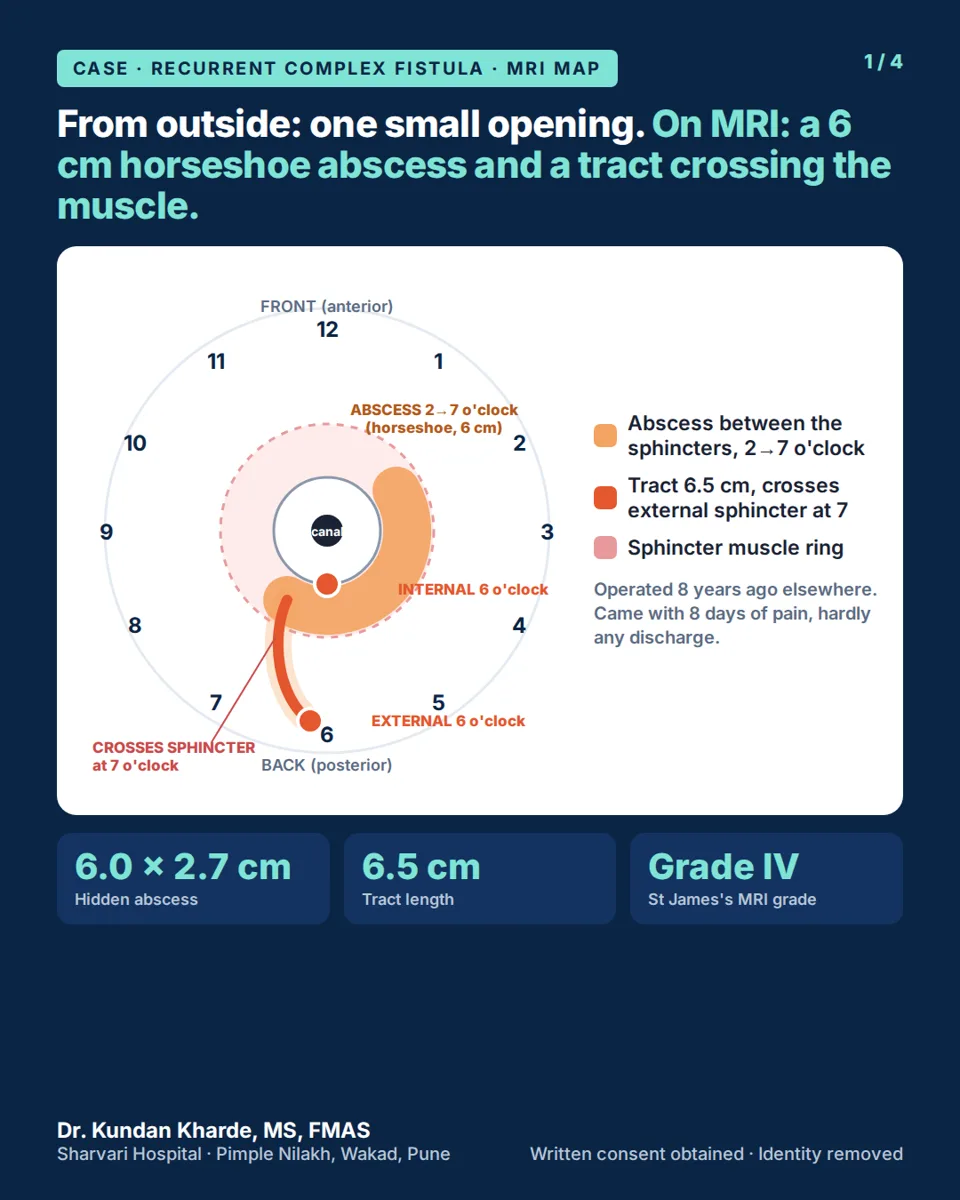
A man in his early 30s, operated for a fistula at another hospital 8 years ago, came to me with 8 days of pain and hardly any discharge — from outside there was just one small opening. I imaged him first, and the MRI fistulogram showed a large horseshoe abscess behind the anal canal, about 6 cm across, with a tract crossing the external sphincter, which makes it a grade IV fistula. I drained the abscess and laid open its inner part, and for the segment crossing the muscle I cored out the tract instead of cutting through it, so the sphincter stayed intact. The rest of the tract was then removed out to the skin. A long-acting local anaesthetic block at the end of surgery kept him comfortable. He went home the next day and is healing on follow-up.
The reasons fistulas recur — what I actually look for
| What I look for | Why it causes recurrence |
|---|---|
| Internal opening never identified | The source keeps feeding the tract. The most common single reason. |
| Secondary or horseshoe tract missed | The main tract heals; the branch keeps discharging. |
| Epithelialised tract | The tract has lined itself and will not adhere and close. |
| Skin closed over an unhealed depth | Infection is sealed in and rebuilds the tract from the inside. |
| Abscess not adequately drained first | Operating into active infection rarely holds. |
| Crohn's disease | A perianal fistula that will not close despite technically sound surgery. |
| Anorectal tuberculosis | Genuinely under-diagnosed in India. Surgery alone will not cure it — ATT is part of the treatment. |
| Wrong technique for the tract | A sphincter-sparing procedure chosen for anatomy it cannot handle, or a laser used where a flap was needed. |
My rule: if a fistula has recurred twice, I investigate for an underlying cause before I plan a third operation. Not after it fails.
Read more: Why fistulas don't heal — the FRIENDS framework · Fistula recurrence prevention
What I choose, and when
I don't have a favourite operation. I have a decision tree.
- Draining seton first — in nearly every heavily recurrent or infected case. It is not a failure, it is stage one. It converts an angry field into an operable one.
- LIFT — where there is a well-formed transsphincteric tract and enough intersphincteric space to work in. Sphincter-sparing, repeatable if it doesn't take.
- FiLaC / laser closure — for suitable tracts including some recurrent ones. Low sphincter risk, and importantly, failure doesn't burn a bridge — you can still do a flap afterwards.
- VAAFT — when I suspect branches. The scope lets me see inside the tract rather than infer it.
- Advancement flap — high tracts, anterior fistula in a woman, or where the internal opening needs healthy tissue brought over it. Technically demanding, and the right answer more often than it gets offered.
- Fistulotomy — only for genuinely low, simple tracts. In a re-operated patient, almost never.
On success rates, honestly: published series report healing broadly in the 60–75% range for LIFT, around 55–70% for laser closure (FiLaC) with pooled figures near 60%, and 60–80% for advancement flaps in appropriate cases. Redo procedures generally do less well than first-time surgery. Anyone quoting you 95%+ for a recurrent complex fistula is quoting the wrong literature.
Compare techniques: FiLaC vs fistulotomy · Laser vs open fistula surgery · Types of anal fistula: simple vs complex
The question everyone is too embarrassed to ask
“Will I lose control of my motions?”
Ask it. It is the right question, and it is the reason I plan these cases the way I do.
Every operation on the anal sphincter spends a small amount of muscle function. A first fistulotomy on a low tract spends almost none. A wide fistulotomy on a high tract in a patient already operated twice can spend a great deal — and unlike a fistula, continence cannot be reliably repaired later.
So in a recurrent case my priority order is:
- Preserve continence.
- Close the tract.
- Do it in as few stages as is safe.
In that order. Not the other way round.
In redo anal fistula surgery, a fistula that recurs can be treated again; sphincter function that is lost usually cannot be restored — which is why sphincter preservation, not speed, should drive the plan.
What to send me for a second opinion
Send these on WhatsApp (+91 99602 83338) and I will review before you travel:
- MRI report and images (if you have a CD or the DICOM link, send that too)
- Previous operative note(s) — every operation, if there were several
- Discharge summary from the last admission
- A short history in your own words — when it started, how many surgeries, when it recurred each time
- Any biopsy or histopathology report
- Whether you have noticed any change in bowel control — be specific and be honest
No photographs are needed for the initial review.
Who I see for this
Patients from Wakad, Hinjawadi, Baner, Aundh, Balewadi, Ravet, Tathawade, Pimple Saudagar, Pimpri-Chinchwad and across Pune — including patients referred from outside Pune specifically for re-operated cases.
Consultations and surgery at Sharvari Hospital, Pimple Nilakh, Pune — ISO 9001:2015 certified, 24×7, cashless with 50+ insurers. Facility, pathway and costs for complex fistula surgery →
A recent case: narrowing and a non-healing wound after piles surgery elsewhere

A young woman in her early twenties came to me after a year of pain and difficulty passing stools that had begun following a piles procedure at another hospital. On examination she had severe anal stenosis with a non-healing wound at the 6 o'clock position. I excised the wound, released the stricture and did a mucoplasty so that the released area was lined with healthy tissue rather than scar. She healed in 6–8 weeks and had no complaints at follow-up.
Questions patients ask me
Is a third fistula operation worth doing?
Why does my surgeon keep putting a thread in instead of curing the fistula?
Can a fistula be cured without cutting the sphincter?
Is an MRI from before my last surgery enough to plan redo fistula surgery?
Could a recurrent anal fistula be tuberculosis?
How long will I be off work after redo fistula surgery?
My fistula came back after surgery — will I lose bowel control if it is operated again?
Can I get a second opinion on my fistula without travelling to Pune?
Written and medically reviewed by Dr. Kundan Kharde, MBBS, MS (General Surgery), FMAS, FIAGES — Laser & Laparoscopic Surgeon, Director, Sharvari Hospital, Pune. 19+ years, 6,000+ surgeries. Last reviewed: 21 August 2026.
Fistula care in Pune
Anal discharge, recurrent abscess, or a stubborn opening near the anus may mean a fistula—not just piles. Explore Dr. Kharde's fistula hub and specialist page before you decide.
This procedure is performed at Sharvari Hospital
Contact Dr. Kharde About Complex & Recurrent Fistula
Get expert complex & recurrent fistula from Dr. Kundan Kharde